
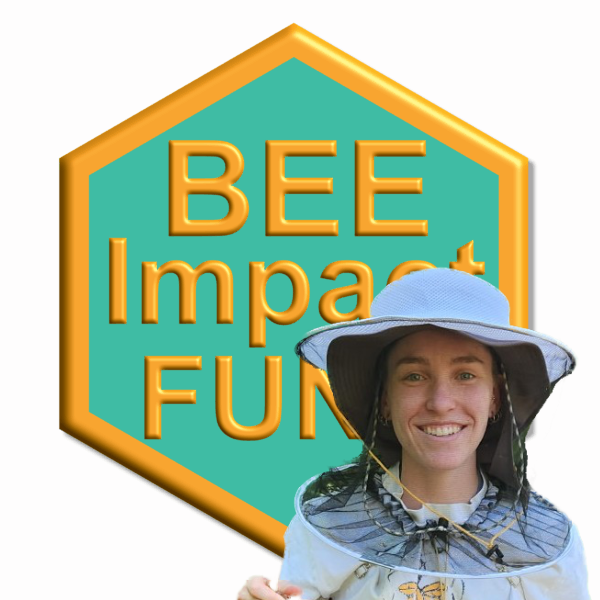
MCBA’s 2026 Bee Impact Fund recipient is Claudia Roller, at North Carolina State University.
Claudia is developing a method to rescue queenless colonies plagued with laying workers. The presence of laying workers often stops the colony from accepting a new queen, dooming them.
YOUR CONTRIBUTION will help Claudia continue researching a promising new technique to get colonies past the laying worker dilema.
Donate Online Below (Preferred!)
Directions for DAF and Checks, click here.

2026 Bee Impact FUND raiser
ABOUT CLAUDIA
Claudia Roller is a researcher at Dr. David Tarpy's the Apiculture Laboratory at North Carolina State University. She coordinates USDA-NIFA Research and Extension Experiential Learning for undergraduates there. She also conducts independent research on queenless colonies. Before joing the lab, Claudia worked for several years with a 150-colony sideliner beekeeping business.
(Note: MCBA also funded an NCSU researcher in Dr. Tarpy’s lab, Molly Carlson, in 2025.)
While Claudia hails from Tucson, Arizona, she majored in biology at Goucher College in Towson, Maryland, so she spent almost five years in our state.
DETAILS ABOUT THE "LAYING WORKER" DILEMMA
How we currently deal with laying workers
Currently, beekeepers addressing laying workers have low-success methods which are destructive of resources and bees.
One involves shaking the nurse bees, the presumed population of laying workers, out on the ground away from the apiary. The idea is they are write-offs, we cannot trust them, as a population, to not lay drones. They may be able to bid their way into other colonies in the apiary.
Another involves taking a capped and open brood comb from another colony, adding it to the afflicted one. The hope is brood pheromone will suggest to the laying workers that there is an active queen present.
A third involves introducing a new queen. But too often that queen is not accepted.